Vanilla Export Types in Madagascar: Pre-Harvest Contracts and Traceable Batches
Vanilla export in Madagascar uses pre-harvest contracts and batch-level traceability to match buyers with set supply, verified origin, and export-ready lots. The main types are contract-based sourcing, traceable batch sourcing, blended lots, and buyer-portal managed shipments. Each one fits a different need for risk, volume, and transparency.
What Are the Main Vanilla Export Types in Madagascar?
Vanilla export types in Madagascar are mainly pre-harvest contract supply, traceable batch supply, blended export lots, and buyer-portal managed shipments. Each type changes how origin is checked, how risk is shared, and how buyers follow quality, timing, and paperwork from farm to export.
| Type | Key Features | Typical Cost | Best For |
|---|---|---|---|
| Pre-harvest contracts | Advance supply commitment, harvest planning, farmgate agreements, clearer grading path | Usually premium-priced for priority access and planning certainty | Buyers seeking stable supply and lower procurement risk |
| Traceable batches | Batch-level traceability, lot coding, origin verification, export documentation | Mid to higher cost depending on grading and audit trail depth | Brands needing strong origin traceability and clean records |
| Blended lots | Inventory pooling, quality consistency, simplified grading, larger export lot sizes | Often lower cost than fully segregated lots | Buyers focused on steady supply and simpler sourcing |
| Buyer portal managed shipments | Shipment tracking, document visibility, status updates, buyer-access shipment portal | Service-based pricing, usually tied to export coordination needs | Teams that want digital oversight and easier coordination |
These vanilla sourcing models sit inside a wider vanilla sourcing model and export procurement structure. The right option depends on what the buyer values most. It may be origin traceability, faster grade selection, or a more flexible export lot. In Madagascar, rural road and inland collection limits can affect farm-level aggregation, so the way lots are built matters as much as the final grade.
How Do Pre-Harvest Contracts Work for Madagascar Vanilla Buyers?
Pre-harvest contracts let Madagascar vanilla buyers secure supply before harvest by agreeing on sourcing terms, expected volumes, quality standards, and delivery timing. This model helps growers plan harvest and curing. It also gives buyers priority access, clearer pricing logic, and more control over supply continuity.
In practice, pre-harvest contracts start with a farmgate agreement or a cooperative-level commitment. Buyer and seller align on crop expectations, grade selection, and the curing stage used for delivery. This helps cut down on supply surprises when the season gets tight. In Madagascar, that early planning matters because harvest timing changes by region and crop cycle, and weather shocks can disrupt supply fast.
Producer cooperatives are often part of this model because they can gather smallholder output and help manage harvest planning across many farms. For buyers, the main value is a stronger link between expected output and export documentation. For growers, the main value is a clearer sales path before the most uncertain part of the season begins. Vanillababa uses this structure to balance procurement risk with visible supply flow.
Compare the Vanilla Export Types by Traceability, Cost, and Buyer Fit
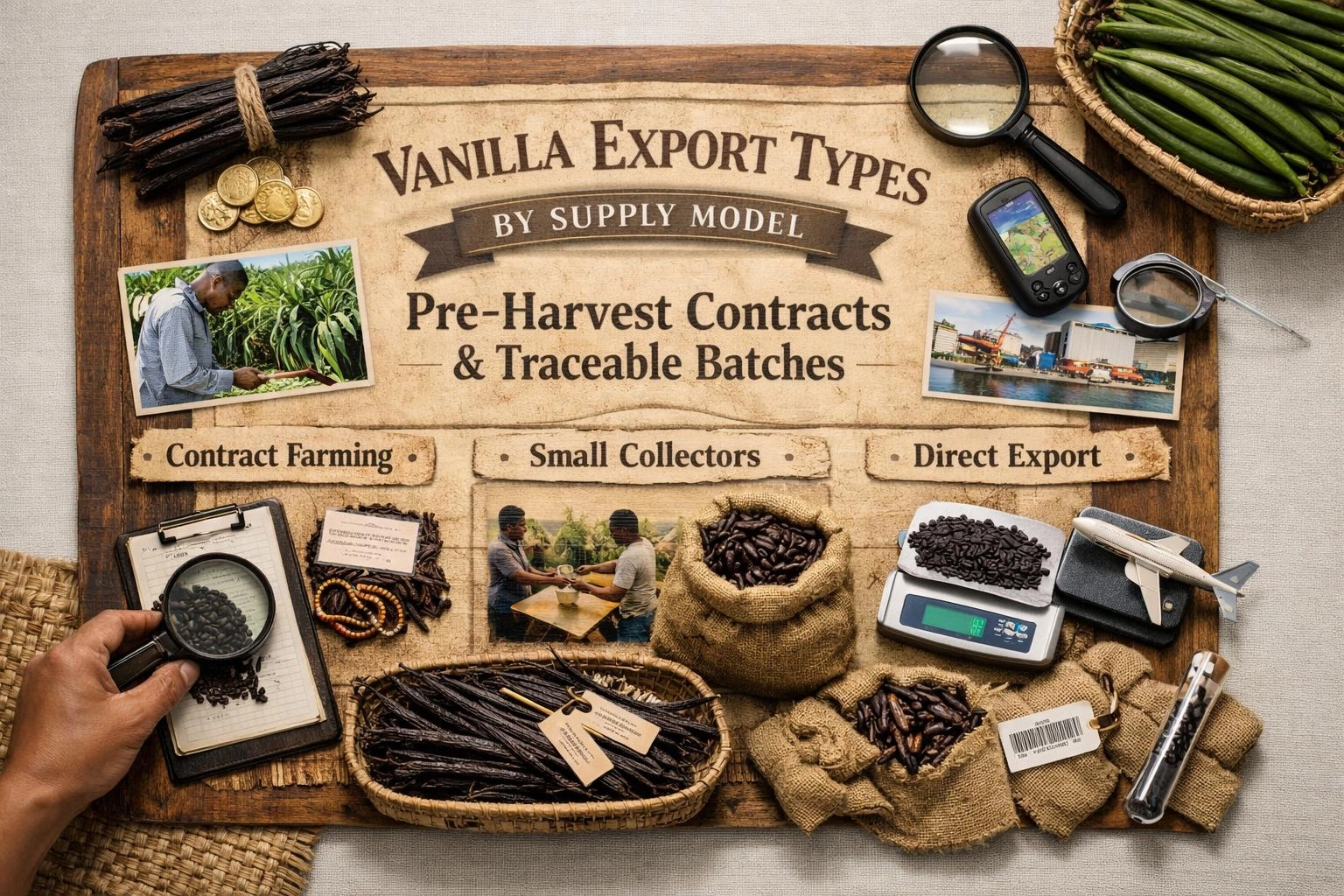
The best vanilla export type depends on how much transparency, control, and continuity the buyer needs. Contracted lots usually offer the strongest planning certainty. Traceable batches give the clearest origin visibility. Blended lots can lower complexity, and portal-managed exports improve document access and shipment oversight.
| Type | Traceability | Export Lot Control | Quality Grading | Buyer Requirements |
|---|---|---|---|---|
| Pre-harvest contract sourcing | High, when the origin record is locked early | Strong supply commitment with planned allocation | Usually aligned to specific grading targets | Best for buyers with forward demand and timing needs |
| Batch-level traceable exports | Very high through lot coding and origin verification | Moderate to strong, depending on farm-level aggregation | Supports precise quality grading and audit trail review | Best for brands needing documentation and origin proof |
| Blended export lots | Lower, because inventory pooling mixes sources | High flexibility for larger export lot building | More consistent appearance, less source detail | Best for buyers who value volume and simplicity |
| Buyer portal managed shipments | High document visibility, moderate origin depth | Good control through shipment tracking and status updates | Depends on underlying lot structure and grade selection | Best for buyers who want digital oversight and coordination |
For export buyers, clean records matter because smallholder sourcing is spread across many producing areas. That is why batch-level traceability and a strong audit trail matter so much. When inland collection is delayed by rural road conditions, well-managed handoffs protect origin traceability and keep export documentation useful, even if the physical movement takes longer.
Pre-harvest Contract Sourcing
Pre-harvest contracts give buyers a supply commitment before the crop is fully collected. This supports price discovery earlier in the season and helps farms and cooperatives prepare curing, grading, and delivery around a known plan. It works best when the buyer needs dependable volume and lower procurement risk.
Batch-level Traceable Exports
Batch-level traceability keeps each export lot tied to a lot code, origin record, and specific handoff points. This is useful when buyers want origin verification and a stronger audit trail. It is especially helpful where rural road delays or multi-point aggregation could otherwise blur the chain of custody.
Blended Export Lots
Blended lots pool inventory to improve quality consistency and simplify export fulfillment. They can work well when buyers want a stable specification without needing source-by-source detail. The tradeoff is less visibility, since farm-level aggregation makes it harder to isolate each origin record.
Buyer Portal Managed Shipments
Buyer portal access gives shipment tracking and document visibility in one place. It helps procurement teams follow export documentation, see status changes, and confirm shipment milestones without repeated manual requests. This is useful when internal teams need a cleaner workflow from lot approval to dispatch.
Dedicated Traceability Programs
Traceable batches under dedicated programs are built for buyers who need a deep audit trail and export compliance support. The model usually combines lot coding, origin verification, and tightly managed export documentation. It is strongest when the buyer must defend sourcing claims and prove chain-of-custody details.
Frequently Asked Questions
Next Step for Buyers
If you need a controlled sourcing plan, compare pre-harvest sourcing contracts, batch-coded export lots, and buyer-access shipment portal options against your own buyer requirements. For Madagascar supply, the right choice depends on harvest planning, grading needs, and how much document visibility your team needs. To review a fit with Vanillababa, use the contact path below.
Request sourcing supportRelated Resources
Certification & Traceability Costs: Organic, Batch Traceability and Export Documentation Premiums
how much extra does organic certification and traceability add to vanilla export cost
What It CostsHow Seasonality and Pre-Harvest Contracts Affect Vanilla Prices in Madagascar
how does Madagascar vanilla season affect prices and what do pre-harvest contracts cost
How It WorksSourcing & Contracting Process for Vanilla Export: Pre-harvest Contracts and Supplier Verification
how does vanilla pre-harvest contract sourcing work for exporters
How It WorksCustoms Documentation & Export Clearance Process for Vanilla: Paperwork, Certificates and Tariffs
what paperwork is needed to export vanilla from Madagascar