Madagascar Vanilla Export Clearance: Paperwork, Certificates, and Tariffs
To export vanilla from Madagascar, exporters need commercial export paperwork, customs declarations, origin and phytosanitary certificates, and buyer or destination compliance documents. The shipment also has to match batch traceability records, packaging labels, and tariff codes before customs clearance. Vanillababa can prepare the documents, check the export file, and support trusted exporter compliance so vanilla moves through Madagascar export clearance with fewer delays.
Vanilla export documentation in Madagascar usually starts with the export declaration, commercial invoice, packing list, and transport papers such as the bill of lading. Exporters also need a certificate of origin and plant-health papers, especially when the shipment includes vanilla bean lots for premium buyers.
In practice, Madagascar export customs checks whether the trade file matches the cargo, the label, and the declared HS code or tariff classification. That means the invoice details, batch records, and shipping documents must line up before a customs broker can move the file forward. At the port, clean paperwork matters because local clearance rules are strict during inspection.
The best export filing is a full trade compliance document set, not just loose customs papers. A good dossier also includes origin verification, batch traceability, and buyer-facing quality notes that support the shipment at destination. Vanillababa often helps exporters gather these export paperwork items into one usable customs documentation file.
What Paperwork Is Needed to Export Vanilla from Madagascar?
Vanilla exports from Madagascar usually need an export declaration, commercial invoice, packing list, transport document, certificate of origin, and phytosanitary paperwork. Depending on the buyer and destination, exporters may also need traceability records, inspection documents, and tariff classification details before customs releases the shipment.
At minimum, the export file should show what is being shipped, who is exporting it, where it is going, and how the batch was prepared. The commercial invoice and packing list must match the physical cargo, while the bill of lading or Other transport paper confirms the handoff to the carrier. A customs broker will often review these shipping documents before filing.
Because vanilla beans are a high-value agricultural product, buyers often expect stronger origin proof than they do for ordinary goods. That is why batch records, invoice details, and the correct HS code matter. If the product description is vague, Madagascar export customs can ask for more proof, which slows export clearance.
Typical paperwork for a clean export filing includes:
Strong customs documentation also helps with tariff logic. When the tariff classification or HS code is correct, the shipment is easier to clear and less likely to face a coding query. If the batch is split across cartons or drums, the details matter too: invoice entries and batch records must connect every package to one traceable export filing.
Which Certificates and Compliance Documents Clear Customs?
Customs clearance for Madagascar vanilla relies on certificates that prove the shipment is lawful, clean, and traceable. The most important documents are the phytosanitary certificate, origin certificate, quality or inspection evidence, and batch traceability files, because these reduce rejection risk at export and import controls.
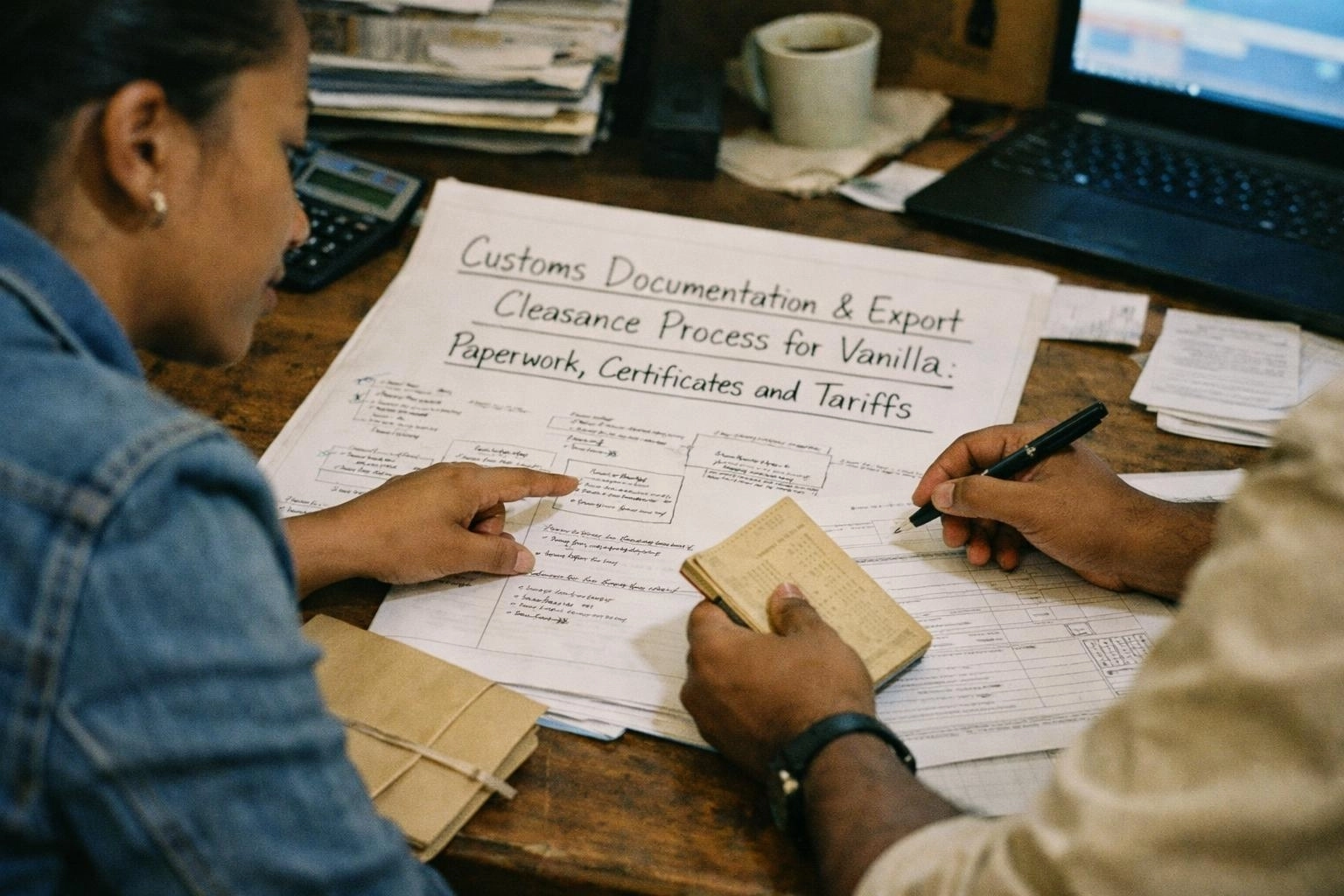
These certificates work together. A phytosanitary certificate covers plant-health compliance, while the certificate of origin supports the claim that the beans are from Madagascar. Quality inspection records help prove the lot is export ready, and batch-level traceability shows how the goods were handled from curing to container stuffing.
For local proof, the port-side inspection culture in Madagascar means document matching is not optional. Incomplete customs documents often lead to extra checks, especially when the cargo value is high. Seasonal harvest and curing cycles can also affect timing, so exporters should align the export permit, inspection, and packing schedule before vessel cutoff.
How Does the Vanilla Export Clearance Process Work in Madagascar?
The vanilla export clearance process in Madagascar starts with document preparation, then customs filing, inspection, verification, and release for shipment. Each step depends on accurate product details, matching certificates, and traceable batch records, because inconsistencies can delay clearance or trigger extra inspection.
1. Prepare the Export File Before Booking Cargo
First, build the export file with the commercial invoice, packing list, certificate drafts, and shipment instructions. The export file should already reflect the correct product description, weights, and destination details so the customs declaration can be filed without rework.
2. Match the Vanilla Batch to Traceability Records
Next, link the vanilla bean lot to curing notes, lot codes, and batch-level traceability records. This audit trail is important in Madagascar export customs because buyers and inspectors want the cargo to match the stated origin and grade.
3. File the Customs Declaration and Supporting Papers
Then the customs declaration is submitted with the shipping documents, invoice details, origin proof, and tariff classification. A customs broker may review the HS code, product description, and value entry before the export filing is accepted.
4. Complete Inspection and Certificate Verification
After filing, customs or a related authority may inspect the cargo and verify certificates. Inspection can include checking package count, seal condition, and document consistency, especially when the lot is high value or split across several cartons.
5. Obtain Release and Move the Shipment to Port
Once the papers are accepted, officials issue a release order so the cargo can move to port and be handed over to the carrier. The final cargo handover should match the release order, bill of lading details, and port handling instructions.
In many cases, the smoothest clearance comes from front-loading verification. If the invoice, certificate of origin, and phytosanitary certificate already match the export declaration, the shipment is less likely to pause during verification. That is why exporters treat export clearance as document control, not only a transport step.
Vanillababa supports this workflow by checking the dossier before filing, which helps reduce last-minute customs questions and makes the handoff to the port team cleaner.
How Long Does Vanilla Export Documentation Take?
Vanilla export documentation time in Madagascar depends on shipment size, document completeness, and inspection requirements. Small batches move faster when records are clean, while larger or multi-batch exports usually take longer because customs checks more paperwork, traceability links, and certificate details.
| Shipment size | Typical documentation lead time | What affects the timeline |
|---|---|---|
| Small shipment | Usually the fastest, often within a short preparation window when the export file is complete | Clean invoice details, one batch, and no document corrections |
| Average shipment | Commonly needs a moderate lead time for certificate collection and review | Standard customs documentation, one or two inspections, and normal verification steps |
| Large shipment | Usually takes the longest because multiple lots and more checks slow the file | Multi-batch traceability, extra inspection, and more cross-checks on tariff classification |
For most exporters, the real variable is not the calendar alone but the quality of the shipping documents. If the batch records, export permit, and certificate set are complete, the process is faster. If the port team finds a mismatch, Madagascar export customs may pause the file until the correction is made.
Because harvest and curing cycles are seasonal, ready-to-ship stock is not always available on demand. That is why documentation lead time should be planned together with production timing, not after the cargo is already booked.
Frequently Asked Questions
Randrianantenaina Landry writes with local export compliance experience for Madagascar trade pages. For vanilla shipments, the safest path is a complete customs documentation file with verified certificates, exact invoice details, and batch-level traceability that matches the cargo from warehouse to port.
For support with export filing, document review, and exporter compliance, use the contact page. A clean export filing is faster to clear when the paperwork, tariff classification, and origin proof all align before shipment.
Related Resources
Certification & Traceability Costs: Organic, Batch Traceability and Export Documentation Premiums
how much extra does organic certification and traceability add to vanilla export cost
What It CostsPackaging, Insurance and Compliance Costs for International Vanilla Buyers
what are packaging insurance and compliance costs for exporting vanilla from Madagascar
Compared ToGrade A Gourmet Vanilla vs Grade B Vanilla: Which Madagascar Export Should You Buy?
Grade A vs Grade B vanilla export Madagascar
Compared ToExport Vanilla to China vs Export Vanilla to Europe: Regulatory, Logistics and Price Comparison
export vanilla to China vs Europe