Grade a Gourmet Vanilla Export Checklist for Madagascar
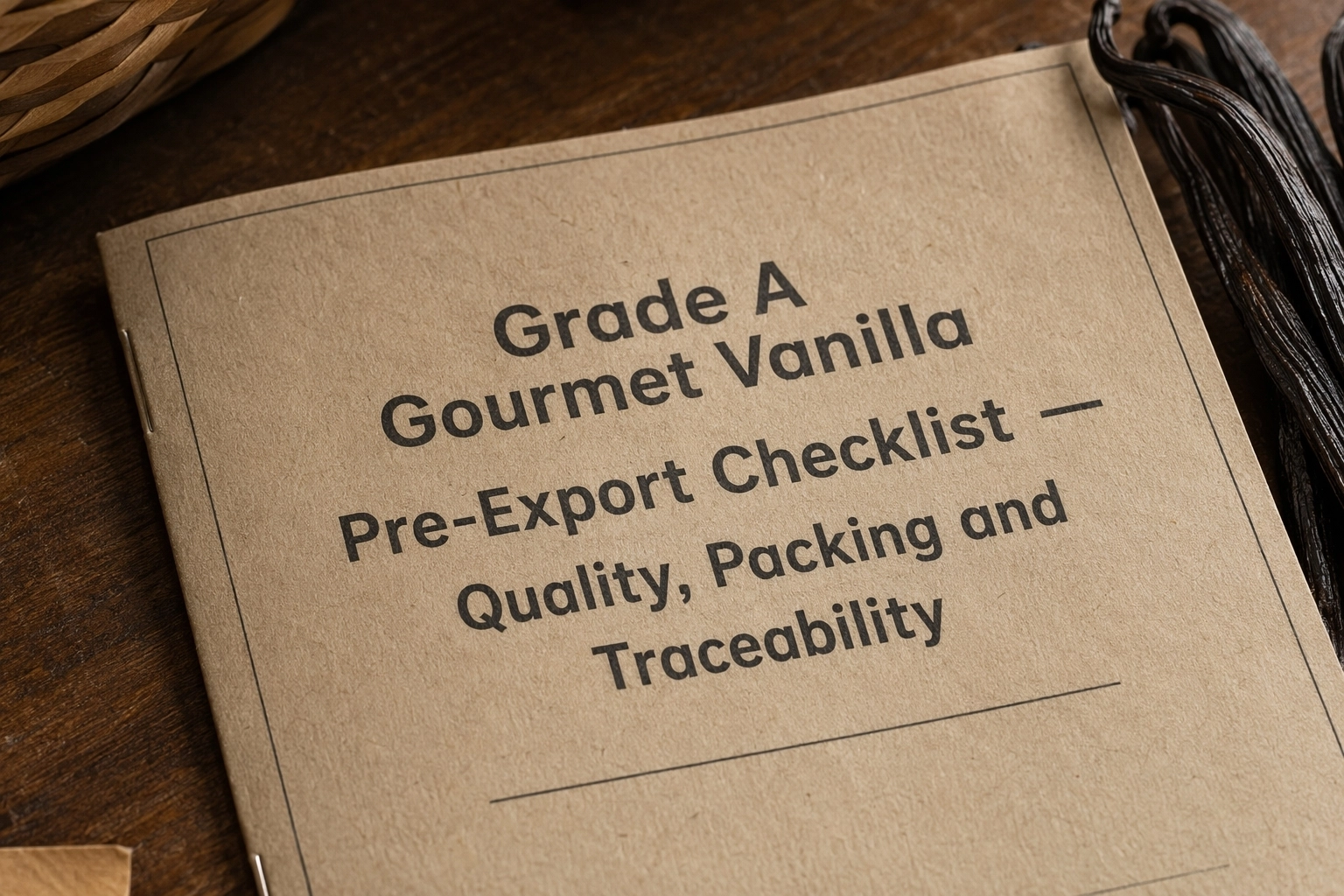
Grade A gourmet vanilla exports need close checks before shipment. You must verify quality, packing, and batch traceability. The checklist should confirm moisture, aroma, appearance, defect limits, safe packaging, sealed lots, labels, documents, and lot records for each batch. In Madagascar, this protects grade integrity, lowers rejection risk, and keeps every vanilla caviar or seed batch traceable from curing to export.
What Must Be Verified Before Grade a Vanilla Leaves Madagascar?
Grade A vanilla must be checked for cure quality, moisture balance, aroma, appearance, defect limits, and lot identity before it leaves Madagascar. This pre-export check confirms the beans, caviar, or seeds meet buyer specs, are packed correctly, and can be traced batch by batch through export documents.
The Madagascar vanilla supply chain adds pressure here because humidity can rise fast in coastal and inland microclimates. That is especially true during storage between curing and pickup. A strong pre-shipment checklist protects premium quality classification, supports export compliance, and helps buyers trust the packed lot verification. In practice, this means one clear lot-by-lot traceability log for each export-ready batch, not a mixed record that blurs origin routing.
Which Packing Steps Keep Vanilla Caviar and Seeds Export-Safe?
Vanilla caviar and vanilla seeds must be packed in clean, food-safe, odor-free, sealed containers that protect flavor, prevent moisture gain, and preserve grade. Export-safe packing also includes correct net weight, tamper control, inner liners, and labels that match the batch and invoice records.
For Madagascar export routes, long inland transport to export points often makes secondary packaging more important than the primary pack alone. Odor-free outer layers help preserve aroma during the road move, and fast handoff limits exposure to heat and moisture. That matters for vanilla caviar and vanilla seeds because these processed forms can pick up outside smells faster than many buyers expect. A careful export packaging routine keeps the lot aligned with buyer specification and lowers damage during port handling.
How Should Batch-Level Traceability Be Documented?
Batch-level traceability should connect every lot to its farm or collection source, curing or preparation date, grade decision, packing record, and shipment documents. This creates a clear chain of custody so buyers, inspectors, and customs can match the exported vanilla to one identifiable batch.
| Traceability element | What to record | Why it matters |
|---|---|---|
| Source lot | Farm, collector, or receiving point linked to the batch code | Shows country-of-origin traceability inside the Madagascar vanilla supply chain |
| Processing record | Curing, sorting, or preparation date and the quality control result | Proves the premium quality classification was assigned with a documented method |
| Packed lot verification | Net weight, container type, seal integrity, and packing label | Keeps the physical pack matched to the commercial invoice and packing list |
| Export file | Lot number, export documents, and certificate references | Supports export compliance and customs documentation review |
| Shipment handoff | Date, handler, storage location, and seal condition at release | Protects chain of custody from warehouse to port |
A practical lot-by-lot traceability log should use one batch code per packed unit group and keep the records easy to read from curing to export. In Madagascar, port-side delays and uneven handling can create lot confusion if labels are weak or documents get separated from the goods. The best export compliance process links each batch number to the commercial invoice, packing list, and buyer specification so no one has to guess which lot was shipped.
What Red Flags Can Cause a Grade a Vanilla Shipment to Fail?
Grade A vanilla shipments fail when they show mold, split or damaged pods, off-odors, contamination, inconsistent moisture, or mismatched labels and lot codes. Red flags also include unsealed packaging, missing traceability records, and grade claims that do not match the physical product.
- Mold or visible contamination on the beans, caviar, seeds, or packing materials.
- Overdrying that leaves the product brittle, weak in aroma, or outside the expected moisture balance.
- Packaging that is open, crushed, or not odor-free, which can distort quality and flavor.
- Labels, batch codes, or records that do not match the lot on the pallet.
These warning signs matter because buyers often inspect both the product and the paperwork together. A lot can fail even if the vanilla looks fine when the chain of custody is broken or the defect rate is higher than the grade claim allows. If you spot these issues early, you can stop a weak shipment before customs review or buyer rejection.
What Records Should Be Ready Before Customs and Buyer Review?
Customs and buyer review need a complete record set that matches the product, batch, and packaging. The file should include the commercial invoice, packing list, phytosanitary and Other export certificates as applicable, batch coding records, and any quality notes that explain how the Grade A lot was verified.
At minimum, the export file should let a reviewer move from the paper trail to the physical lot without confusion. That means the commercial invoice should match the packing list, the phytosanitary certificate should match the product description, and the batch code should appear in each relevant export document. If a lot was reworked, split, or repacked, the notes should explain it clearly so the chain of custody remains intact.
For Madagascar shipments, this documentation matters even more when inland transport takes time and port-side delays create gaps between packing and departure. A neat record set helps customs, brokers, and buyers confirm export compliance fast. It also reduces the chance that a good-grade batch is delayed simply because a label, quantity, or certificate detail was left out.
How Does Madagascar Context Change the Checklist?
Madagascar changes the checklist because humidity, regional handling conditions, inland transport time, and port logistics can affect moisture, aroma retention, and packaging integrity. A strong export checklist in Madagascar must account for local drying conditions, storage risk, and the time gap between lot preparation and shipment.
In practice, Madagascar seasonality can shift how fast a batch stabilizes after curing, so quality control should confirm moisture content again before release. Coastal and inland microclimates may call for tighter sealed packaging, especially for higher-value lots moving through warm storage areas. Local handling also matters: rough loading, open warehouses, and delays between collection and handoff can weaken odor-free packaging or blur lot number visibility.
Because port logistics can change quickly, the best process is simple and repeatable. Keep the packed lot verification close to dispatch time, keep labels easy to read, and keep the export documents in the same order as the pallets. That way the premium quality classification stays believable from the farm gate to the export point.
Frequently Asked Questions
Written by Randrianantenaina Landry
Contact Vanillababa for export readiness support
Get a Free EstimateRelated Resources
Cost Comparison: Grade A Gourmet Vanilla vs Grade B Vanilla (Madagascar Bourbon)
how much does Grade A vs Grade B Madagascar vanilla cost
What It CostsPricing Guide: Whole Pods, Vanilla Cuts, Extract, Paste and Powder
how much does vanilla extract paste powder pods cost
What It CostsCertification & Traceability Costs: Organic, Batch Traceability and Export Documentation Premiums
how much extra does organic certification and traceability add to vanilla export cost
What It CostsHow Seasonality and Pre-Harvest Contracts Affect Vanilla Prices in Madagascar
how does Madagascar vanilla season affect prices and what do pre-harvest contracts cost