Madagascar Vanilla Export Costs to China, Europe, USA, and UAE
Exporting Madagascar vanilla to China, Europe, the USA, or the UAE usually costs more than the farm-gate price because landed cost includes export packing, inland transport, freight, insurance, customs clearance, duties, and destination fees. China and the UAE often price differently from Europe and the USA because each market has its own import rules, tax setup, and broker charges. Buyers should compare CIF or DDP quotes, not just product price, and ask for a market-specific landed cost estimate before ordering from Madagascar.
What Does It Cost to Export Madagascar Vanilla by Market?
Madagascar vanilla export cost varies by destination because freight, import duties, VAT or GST, customs clearance, and local delivery charges change by market. A buyer should budget for product price plus shipping and landing costs, with Europe and the USA usually adding more compliance and tax steps than some regional markets.
Below is a buyer-facing view of typical export pricing logic by destination. These are sample ranges, not fixed tariffs, because freight forwarding, customs broker work, port charges, and country of origin paperwork can move the total up or down. The same bulk vanilla bean export shipment can land differently in Shanghai, Rotterdam, Los Angeles, or Dubai depending on the route and service level.
| Market | Typical export price focus | Main landed-cost drivers | Buyer note |
|---|---|---|---|
| China | CIF quote for wholesale vanilla beans | Freight, customs clearance, broker charges, import rules | Price can move with port choice and document quality |
| Europe | CIF or DDP quote | Import VAT, customs duties, food-grade compliance, destination charges | Often has more compliance steps for food imports |
| USA | CIF plus local entry costs | Freight, customs brokerage, FDA entry handling, local delivery | Entry checks can add time and cost |
| UAE | CIF for import or DDP for regional supply | Destination fees, re-export handling, clearance, storage | Can work well as a re-export hub |
For Madagascar vanilla, the farm-gate figure is only the starting point. Seasonal supply and curing conditions can push grades higher or lower, and that changes packing, inspection, and export price outcomes. Because the island depends heavily on port access, inland-to-port logistics are a major line item before freight forwarding even begins.
Typical Export Pricing Tiers for Madagascar Vanilla
Madagascar vanilla export pricing is usually quoted in tiers based on grade, packaging, shipment size, and Incoterms. Basic pricing covers bulk product and export packing, standard pricing adds freight and document support, and premium pricing includes stronger traceability, tighter selection, and destination handling for wholesale buyers.
These tiers help buyers compare export cost, shipping cost, and final landed cost without mixing service levels. A small order of wholesale vanilla beans often needs more handling per kilo than a consolidated pallet, while larger lots may get better freight efficiency and simpler customs fee planning.
| Tier | What is included | Typical price range | Best for |
|---|---|---|---|
| Basic export | Product, standard export packing, basic documentation | Lower range of wholesale export pricing | Buyers managing freight and destination charges themselves |
| Standard export | Product, improved packing, documentation support, freight coordination | Mid-range wholesale vanilla bean export pricing | Importers wanting a balanced CIF quote |
| Premium export | Selected grade, traceability, stronger handling, destination assistance | Upper range for premium lots | Food brands needing food-grade compliance and consistency |
Basic, Standard, and Premium Landed Cost Comparison
Landed cost depends on the quote type: a CIF quote usually covers product plus freight and insurance, while a DDP quote tries to include more destination-side charges. Basic tiers keep the export price lean, standard tiers cut quote gaps, and premium tiers reduce surprises for buyers who need cleaner customs clearance.
| Quote type | Cost coverage | Typical use | Risk of extra charges |
|---|---|---|---|
| Basic | Product and packing only | Buyers with their own freight forwarder | High if destination fees are not planned |
| CIF | Product, freight, shipping insurance | Most common cross-border trade quote | Medium, because import duties and VAT remain |
| DDP | Product, freight, insurance, and many destination charges | Buyers needing clearer all-in pricing | Lower, but only if terms are written clearly |
Which Charges Make Up the Final Landed Cost?
The final landed cost of Madagascar vanilla is built from several parts: the product price, inland transport in Madagascar, export packing, international freight, insurance, customs paperwork, duties, VAT or GST, and destination-side brokerage or delivery charges. The same shipment can cost very differently in China, Europe, the USA, and the UAE.
In practical terms, the invoice starts in Madagascar with the country of origin price and moves through cross-border logistics. Export compliance may include phytosanitary and document steps before departure, and those steps add time and handling cost. A customs broker, shipping line, and freight forwarding partner each add a separate part of the total trade bill: freight charge, customs fee, and port charges.
For food-grade compliance, wholesale vanilla beans must be packed, labeled, and documented in a way that supports import clearance. Shipping insurance protects the value in transit, but it does not remove destination charges. Customs duties and import VAT can also change the final number, especially where tax treatment is tied to product classification or local distribution rules.
How Do China, Europe, USA, and UAE Differ on Import Costs?
China, Europe, the USA, and the UAE apply different import processes that change the total cost to import Madagascar vanilla. Europe often adds stronger customs and VAT treatment, the USA may involve stricter food entry checks, China can add broker and clearance complexity, and the UAE can be cost-efficient for re-export or regional distribution.
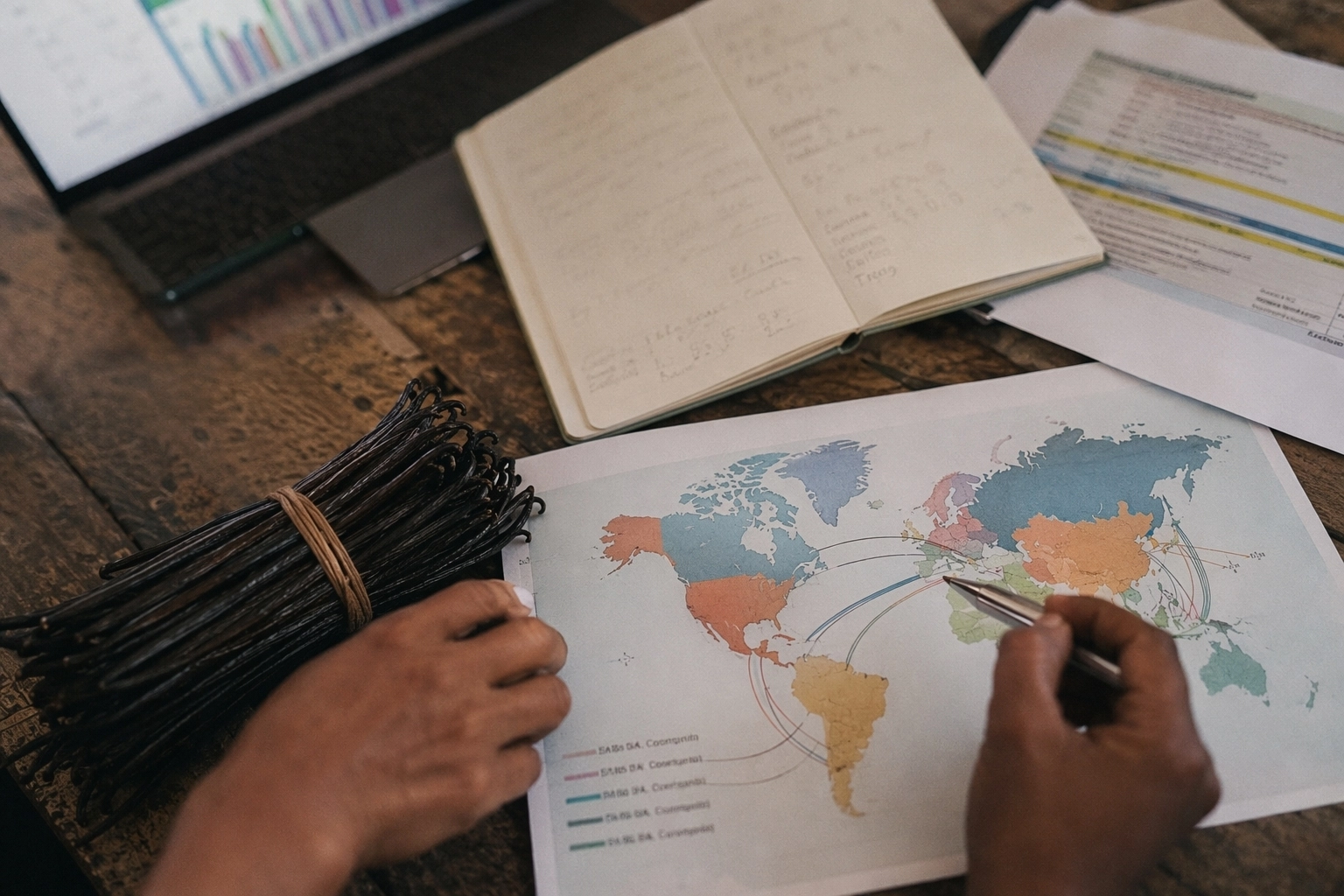
China import rules can affect which documents the customs broker needs before release, so a quote should reflect clearance effort as well as freight. Europe often treats import VAT as part of the overall landed cost, which can make the all-in number look much higher than the export price alone. In the USA, FDA review and food-related entry steps can slow release if paperwork or labels are weak.
The UAE is often used as a re-export hub, so buyers there may compare a local import with a wider regional distribution model. That changes the shipping cost structure because destination charges, warehouse handling, and onward movement may matter as much as the base price. Across all four markets, the biggest mistake is to compare product only, not landed cost.
How Can Buyers Reduce Vanilla Export Costs Without Cutting Quality?
Buyers can reduce Madagascar vanilla export costs by consolidating shipments, choosing the right Incoterms, improving packaging, planning around freight cycles, and confirming destination charges before shipping. These steps cut waste and surprise fees while keeping bean grade, moisture control, and traceability intact.
These habits matter because island logistics can create delays if the port plan is weak. Madagascar’s geography makes export timing depend on inland access and vessel schedules, so a well-planned shipment usually saves more than a last-minute rush. Buyers who balance service level and route choice can keep quality high while lowering shipping cost.
What Should a Buyer Ask for Before Requesting a Quote?
A buyer should ask for a quote that states the vanilla grade, quantity, origin in Madagascar, destination port or airport, Incoterms, packing method, and whether duties and local delivery are included. Without those details, export pricing cannot be compared accurately across China, Europe, the USA, and the UAE.
For Randrianantenaina Landry, the most useful quote is one that separates product price from freight forwarding, customs duties, import VAT, and delivery. That level of detail helps a buyer compare markets fairly and avoid paying for services they do not need.
Frequently Asked Questions
Get a Market-Specific Quote for Madagascar Vanilla
Request a quote that matches your destination, Incoterms, and document needs so you can compare export cost and landing cost fairly. A clear quote should show freight, customs clearance support, customs duties where relevant, and any destination charges for your market.
If you want a China, Europe, USA, or UAE shipment priced properly, share your quantity, grade, port, and timeline. That allows a freight forwarding plan that fits your route, your compliance needs, and the true cross-border logistics cost.
Related Resources
Madagascar Vanilla Export: Step-by-Step Export Process for Bourbon Vanilla
how does Madagascar vanilla export process work step by step
How It WorksLogistics, Packaging and International Shipping Process for Vanilla Exports
how does shipping and logistics work for vanilla export from Madagascar
How It WorksOrder Management & Buyer Fulfilment Process for International Vanilla Purchases
how does the vanilla export order and fulfilment process work for buyers
Compared ToGrade A Gourmet Vanilla vs Grade B Vanilla: Which Madagascar Export Should You Buy?
Grade A vs Grade B vanilla export Madagascar