Trusted Local Service Experts
Export process: 7 step checklist (sourcing to shipment)
Direct answer: The export workflow is seven steps from sourcing to shipment, each step ensuring Grade A quality, compliance and logistics readiness.
- Source and collect — Buy cured or newly harvested pods from smallholder farmers and collector cooperatives. Establish lot traceability and initial moisture checks on delivery.
- Grading and sorting — Sort beans into Grade A and lower grades by length, appearance, and flexibility. Record lots and separate hyponyms like vacuum-sealed vanilla pods for wholesale.
- Curing and moisture control — Apply the standard curing process (blanching, sweating, drying, conditioning) to stabilise flavour and lower moisture content to typical export ranges; recheck prior to packing.
- Quality testing — Run GC/MS testing for vanillin profile and contaminants, plus visual and olfactory checks. Use laboratory results to confirm lot acceptance before export.
- Documentation and permits — Prepare invoices, packing lists, Certificate of Origin, and obtain the mandatory phytosanitary certificate and any Madagascar export permits; file documents for Madagascar Customs.
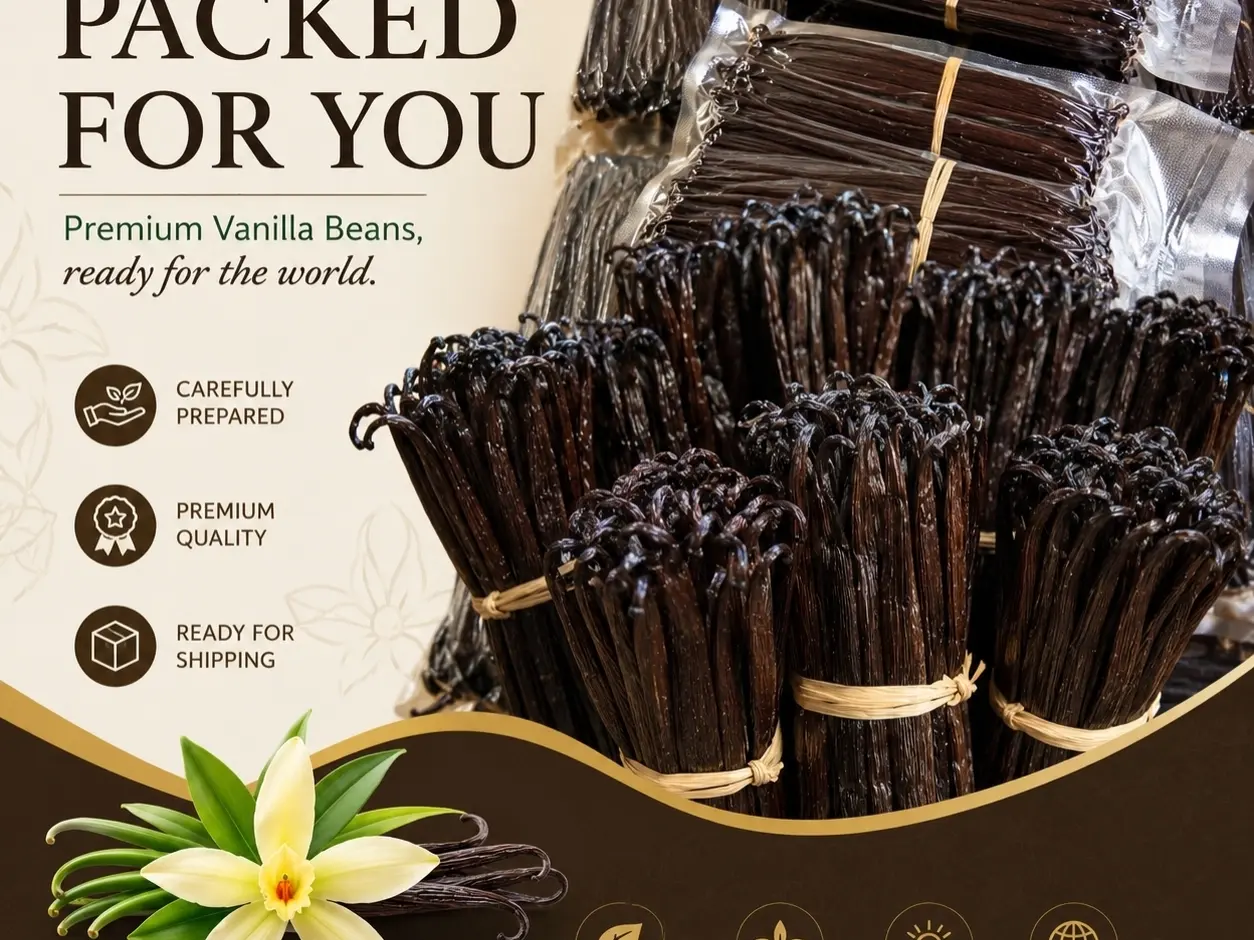
- Packing and logistics — Pack into bulk shipment lots or retail-ready vacuum-sealed pods; agree Incoterms and shipping schedule with the buyer, and arrange fumigation if required by the importer or phytosanitary rules.
- Customs clearance and shipment — Clear Madagascar Customs, present permits and certificates, complete any fumigation or inspection, then ship under agreed Incoterms to Europe with carrier tracking and buyer notification.
Each numbered step requires record keeping for lot traceability and quality control. Exporters like Vanillababa build SOPs for grading, curing, GC/MS testing and phytosanitary compliance so batches move smoothly from farmer cooperative pools to EU wholesale buyers under common Incoterms.
Step details: sourcing, farmer collection and pooling
Direct answer: Sourcing focuses on contracted buys from smallholder farmers and aggregator cooperatives that collect pods by lot and time of harvest.
Teams from exporters visit rural producers to check harvest readiness and arrange collection dates. Smallholder farmers supply most pods; collector cooperatives consolidate small lots into exportable volumes. Vanillababa typically signs purchase notes with cooperatives, pays based on preliminary grading, and documents lot origin for traceability. Early checks include visual sorting, basic moisture checks and embargo tagging if curing is needed. Good sourcing reduces rework later in the curing and GC/MS testing stages and supports compliance with EU import rules.
Step details: grading, curing and moisture control
Direct answer: Grading separates Grade A vanilla beans from lower grades; curing and controlled drying control moisture content to preserve flavour and prevent mould.
Grade A is defined by length, flexibility, oiliness and lack of defects; graders use standard templates and sample lots for GC/MS confirmation. The curing process—blanch, sweat, sun/dry, condition—reduces moisture content into the target export band and develops vanillin. Moisture meters and routine sampling enforce consistency. Proper curing produces uniform vanilla bean cure and lowers rejections at inspection and in Madagascar Customs checks. Vacuum-sealed vanilla pods or bulk lots are packed only after final moisture validation.
Timeline: typical duration by project size
Direct answer: Typical durations vary by project size; most projects fall between short collection cycles and multi-month processing for large wholesale lots.
| Project size | Typical duration (illustrative ranges) | Key time drivers |
|---|---|---|
| Small | 2–6 weeks (most small orders) | Local collection, quick curing, small-batch GC/MS |
| Average | 1–3 months (typical wholesale) | Cooperative pooling, standard curing cycles, documentation |
| Large | 3–6+ months (bulk export projects) | Extended curing, multiple lots, full compliance & fumigation |
These timelines are illustrative. Delays often come from seasonal harvesting, extended curing to reach desired vanillin levels, additional GC/MS rounds, or Madagascar Customs and phytosanitary inspections. Planning around these typical ranges helps align Incoterms, shipping windows and buyer expectations.
Documentation, testing and compliance checklist
Direct answer: Exporters must provide a phytosanitary certificate, Certificate of Origin, GC/MS test reports, export permits and Madagascar Customs clearance documents.
- Phytosanitary certificate — Mandatory export requirement confirming absence of quarantine pests; arrange with national plant health authority before Madagascar export clearance.
- Certificate of Origin — Confirms the product is Bourbon vanilla from Madagascar and supports customs classification and preferential trade if applicable.
- GC/MS testing — Lab method to verify vanillin profile and screen for contaminants; include signed lab reports with the shipment for buyer confidence.
- Export permits — Local permits required for commodity trade; file with Madagascar Customs and retain copies for the importer.
- Packing list & invoice — Detailed packing showing vanilla bean lots, weight, moisture content, and lot traceability numbers.
- Fumigation or inspection certificates — If required by EU importer rules or phytosanitary findings, complete prior to export.
- Madagascar Customs clearance—Final regulatory authority for outbound goods; ensure all documents are presented to avoid hold-ups.
Keep originals and digital copies. Vanillababa and similar exporters archive GC/MS results, lot traceability records and curing logs to meet EU import rules and buyer audits.
Logistics, Incoterms and delivering wholesale to Europe
Direct answer: Choose Incoterms early, coordinate shipping and fumigation, and match packing to wholesale delivery requirements to Europe.
Logistics planning covers carrier booking, container loading for bulk shipment, and documentation handover under agreed Incoterms. Common Incoterms used in vanilla trade include FOB, CIF and DAP depending on who handles freight and insurance. Shipping often uses standard dry containers; cold chain is rarely required for cured vanilla but humidity control and dry cargo handling matter. Arrange carrier manifests and coordinate Madagascar Customs exit clearance. For wholesale deliveries, consolidate lots, label with lot traceability IDs, and provide GC/MS and phytosanitary certificates to the buyer and the EU importer to smooth release at destination ports.
Frequently Asked Questions
Vanillababa—business exporter based in Madagascar—offers buyer-ready Grade A Bourbon vanilla (Vanilla planifolia from Madagascar) and supports GC/MS testing, phytosanitary certification and Madagascar Customs clearance to streamline bulk shipment to Europe. For export support and wholesale enquiries, see /contact/.
Related Resources
Cost Comparison: Grade A Gourmet Vanilla vs Grade B Vanilla (Madagascar Bourbon)
What It CostsExport Pricing to China, Asia, Europe, America and UAE: Freight, Duties and Landing Costs
What It CostsSmall Quantity vs Wholesale Vanilla Pricing: Per-Kg Breakpoints and MOQ Effects
What It CostsHow Seasonality and Pre-Harvest Contracts Affect Vanilla Prices in Madagascar